
What separates premium fragrance manufacturing from ordinary production is rarely the ingredient list. It is the number of points at which someone checks the work and the record that proves the check happened. A high-end programme runs gates at the formula, the materials, the compound, the fill, the decoration and the finished unit, and each gate exists to catch a specific class of problem before it becomes a shipment. The gates are cheap; the failures they prevent are not.
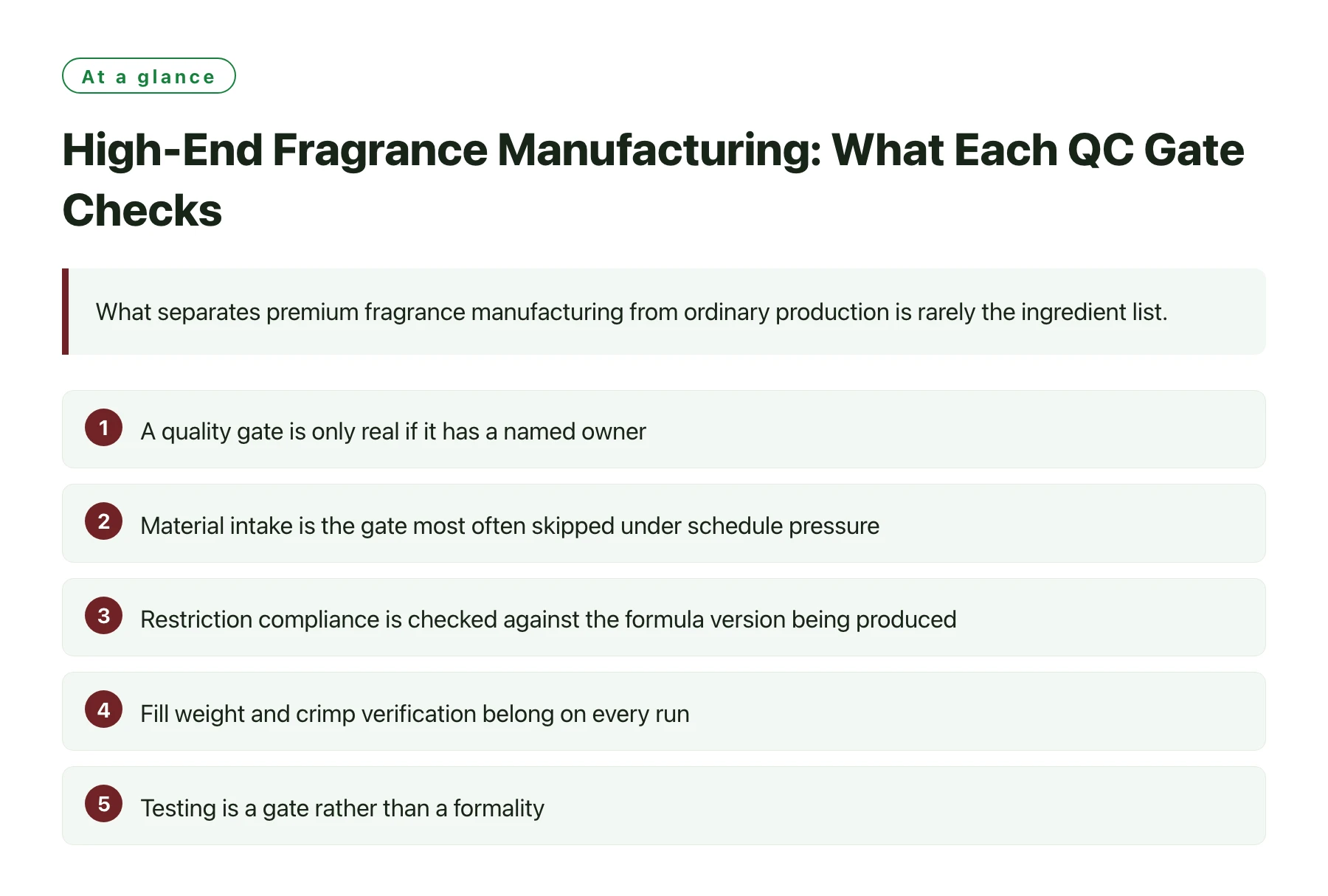
Key takeaways
- A quality gate is only real if it has a named owner, a written criterion and a record produced at the time it is passed.
- Material intake is the gate most often skipped under schedule pressure, and it is the one that controls whether a batch can later be traced to a single delivery.
- Restriction compliance is checked against the formula version being produced, not against the version that was sampled months earlier [1].
- Fill weight and crimp verification belong on every run, because a bottle that leaks in transit is a quality failure regardless of how the scent was judged.
- Testing is a gate rather than a formality, and independent laboratories describe the cosmetics testing scopes they offer openly, which makes the described work checkable [2].
A quality manager at a premium fragrance plant describes the difference between two production lines in a single sentence: on one line the first person to notice a defect is usually the customer, and on the other it is a technician at a gate. The second line is not staffed by more careful people — it has more places where the work stops and is checked.
That is the whole idea behind gates. Each one is a defined moment where production pauses, a criterion is applied, and a record is produced. Some gates are technical and some are documentary, and a premium programme needs both, because a beautiful compound in a leaking bottle is not a premium product.
This walkthrough lists the gates in the order they occur, what each one is checking for, who should be signing it, and the evidence that should exist afterwards. It is written for a brand preparing a creator-led launch, where the volume may be modest but the visibility is not: a single packaging failure is filmed and shared.
The gates, in the order they occur
| Gate | What is checked | Who signs | Evidence to keep |
|---|---|---|---|
| Formula release | That the version being produced is the version that was approved, and that its restriction position covers the category being made | Quality lead and brand sign-off | Released formula version with a date and a restriction statement |
| Material intake | Identity, lot number, supplier documentation and condition at receipt | Receiving and quality | Lot list tying each material to the batch that will use it |
| Compounding | Weights, order of addition, mixing parameters and in-process observations recorded as they happen | Compounder and countersignature | Compounding record with timestamps and any deviation noted |
| Bulk check | Appearance, odour against the reference and, where specified, measured parameters | Quality | Bulk comparison note against the retained reference |
| Fill and crimp | Fill weight, neck sealing, pump or cap function and leak behaviour on a sample pulled during the run | Line quality check | In-process fill and crimp record with sample results |
| Decoration | Print or coating alignment, colour against the approved standard, adhesion and finish | Decoration quality | First-off sample approval plus retention of the approved decorated unit |
| Release and retention | Final visual and functional check, labelling correctness and retained sample sealed from the run | Quality lead | Release note, retained reference and batch record filed together |
Seven gates sounds heavy, and on a small run several of them take minutes rather than hours. Their value is cumulative: each one makes the next one cheaper, because a problem found at material intake never reaches the fill line. A programme run by a manufacturer for luxury fragrance brands is usually distinguished less by the smell of the sample and more by the fact that all seven records exist when the run is finished.
Where premium programmes actually fail
Failures cluster in three places, and none of them is the formula.
The first is a gate that exists on paper only. A specification lists an intake check, but on a busy week the delivery is signed in and used. The consequence appears months later, when a customer reports a variation and there is no lot list to narrow it down.
The second is a gate with no criterion. Inspectors are told to check the crimp, but nothing states what an acceptable crimp is, so the check becomes a habit of looking rather than a measurement.
The third is evidence kept in the wrong place. Records that live on a phone, a shared drive and a notebook are effectively three partial records. The remedy is mundane: one batch file, closed at release, holding the records for that run together.
Testing belongs at a gate, not in a folder
Compatibility and stability work has a natural position in the sequence: after the fill formula is frozen and before the bulk run is released. Testing that is described in general terms is difficult to verify, which is why the specific scope matters — laboratories publish their cosmetics testing services so that a buyer can tell whether the named work is work that can be performed [2].
For an influencer launch, the test report also has a second use. When a follower asks whether the product has been tested, the answer is a document rather than an assurance.
The human gate that is hardest to replace
Odour evaluation against the retained reference is the one gate that no instrument replaces, and it is the one most dependent on training. A trained evaluator can describe a drift in a bulk batch that a specification cannot express, because the specification was written from a sample and the batch is being compared with it.
This is where structured training pays for itself. Sensory programmes teach a panel to name what has changed rather than to say that something feels different, and that vocabulary is what turns a rejection into an instruction. Investing in professional scent training is a quality investment as much as a creative one.
If only one part of this can be tightened before a first premium run, tighten the retention rule: one sealed reference sample per batch, kept by the party that will produce the reorder, filed with the batch record. Retention is what converts seven gates into a system, because it is the object every later comparison is made against. It is also the practical test of whether a supplier's quality control in luxury fragrance production is a process or a promise.
Sources
- IFRA Standards Library (International Fragrance Association) —— The IFRA Standards Library lists the restrictions the fragrance industry applies to individual fragrance ingredients, based on safety assessments; it is the reference point for compliant fragrance formulation.
- SGS: Cosmetics, Personal Care & Household Testing —— Testing, inspection and certification services for cosmetics and personal care, including microbiological, stability and safety testing aligned with cosmetics GMP.
Frequently asked questions
How many quality gates does a premium fragrance run need?
The number matters less than the coverage. A programme should check the formula version, the incoming materials, the compound, the bulk, the fill, any decoration and the released unit, each against a written criterion. On a large run those gates are separate stations; on a small run several may be combined, but none should disappear.
What is the difference between a deviation and a defect?
A deviation is a recorded departure from the stated process, such as a mixing time that ran long. A defect is a failure against a specification. A good record captures deviations as they happen, because a deviation that is not written down cannot be assessed later when the batch is being judged.
Should decoration be checked before or after filling?
Decoration is normally checked on the decorated component before filling, and then again on the finished unit, because filling can damage a finish and transport can damage a cap. The first-off sample approved at the decoration stage becomes the standard the rest of the run is compared against.
How is a bulk batch compared with the approved sample?
By evaluating the bulk against the retained reference from the approved batch, at a defined dilution and on a defined medium, by someone trained to describe differences. The comparison should be recorded even when the batch passes, because the note is what shows the check took place.
Does a small first order need the same quality system as a large one?
It needs the same gates, scaled to the run. The records are the part that should not be scaled down: a first order with a complete batch file gives a brand a baseline for every subsequent order, and it is far easier to establish that practice at the start than to introduce it later.