
925 Silver Jewelry Production: Polishing and Finishing
A silver casting leaves the mould with a dull skin, a parting line and a stub where the sprue was cut. Everything a buyer sees in the case is created in the next three operations: polishing, surface art and electroplating. In the published eight-step route those are steps four, five and six, so three of eight stages — 37.5% — exist purely to turn a cast shape into a finished piece.

Key takeaways
- Polishing, surface art and plating account for 3 of the 8 published factory steps, or 37.5% of the route.
- The 925 sterling silver line runs at a 50-piece MOQ per design, the lowest of the three material lines.
- Anti-tarnish e-coating is offered on silver and brass and sits after plating, not before it.
- Final QC inspects 100% of pieces, so a 50-piece run produces 50 inspections rather than a five-piece sample.
Why the polish decides how the plating looks
Electroplating does not fill a surface; it follows one. A scratch a fraction of a millimetre wide becomes a visible line once a bright rhodium or gold layer sits on top, because the deposit is thin and conformal. That is why polishing belongs in the specification, not in the cleanup at the end.
The polishing stage has two jobs. It removes the casting skin, the dull outer layer left by the mould, together with the parting line and the sprue stub. It also brings the whole surface to one level, so the reflection reads continuously instead of breaking into patches.
Bench polishing runs through graduated abrasives, coarse to fine, then a final high-gloss pass on a wheel. Each grade removes the scratches left by the one before. Skip a grade and the next one cannot hide the damage; the plate simply makes it easier to see. The eight-step route published by TTT Jewelry places polishing before surface art and plating for exactly that reason.
Cleanliness between steps matters as much as the abrasive. Polishing compound left in a recess, or a dust particle on the surface, becomes a pit or a blister under the coating. Factories that plate in-house control that handover; factories that send work out lose sight of it. Keeping the eight-step route under one roof is one way to shorten the gap between the wheel and the tank.
Surface art: brushed, textured and masked
Brushed and textured work is grouped in the published route as surface art, step five, between polishing and electroplating. The label covers directional satin lines, stippled fields, hammered planes and similar effects. All of them are cut into the surface in a controlled pattern rather than applied on top of it.
A single piece can carry more than one finish. A mirror shank with a brushed head, or a textured field around a bright bezel, is common in silver collections. Multiple finishes require masking: part of the piece is protected while the wheel or brush works the rest, then the mask comes off and the order reverses for the next area.
Each added finish adds handling. A single-finish design visits the surface bench once. A two-finish design may visit it twice, with a masking step between passes. That is bench time inside the 21–28 day production window, and it is better written into the spec than discovered at the sample stage.
Hallmarks interact with the sequence. Laser engraving of S925 or 18KGP usually happens late, because engraving after plating cuts through the coating and exposes the metal beneath. Where a mark must sit on a polished face, engraving depth and plating order need to be agreed as one decision.
Electroplating over silver: colour, barrier and compliance
Sterling silver accepts rhodium and gold tones. Rhodium gives a white, hard-wearing surface. Multi-layer 14K, 18K and 24K gold give warmer colours, with 24K reading the deepest yellow. Those four finishes form the published plating menu, and the number of layers is a specification choice rather than a fixed default.
On silver and brass, an anti-tarnish e-coating can be applied after plating. The mechanism is a barrier. Silver tarnishes when sulphur compounds in the air reach the surface and form a dark film, and a cured coating slows that contact. The coating does not change the colour; it changes how long the colour survives handling, humidity and display lighting.
Plating chemistry is constrained by compliance. The published position is that plating is 100% compliant with REACH and CA Prop 65, which limits lead, cadmium and nickel in both finishes and base alloys. ISO 9001:2015 is the framework that keeps bath records and batch traceability attached to those steps, so a finish can be traced back to a run rather than to a memory.
The same colour across different materials is not the same process. Rhodium over silver is electrolytic. A gold-coloured stainless piece is normally PVD, a vacuum coating. Brands building a mixed-material range can read the stainless steel jewelry manufacturer route to compare the two, because a visual match is a specification question before it is a colour-card question.
What to check on a silver sample
Finishing faults show up more clearly under a window than under a shop lamp. The table maps the four checks to the published operations and names the failure each one catches.
| Operation | What it is for | Failure it catches | How to check |
|---|---|---|---|
| Polishing | Removes casting skin, parting lines and sprue stubs | Residual scratches, flat spots, softened edges | Tilt the piece towards daylight; scratches cross the reflection |
| Surface art | Adds brushed or textured fields | Uneven direction, bleed past a masked edge | Compare both sides under the same light |
| Electroplating | Adds colour and wear resistance | Patchy colour, pits, bare corners | Inspect edges, inner curves and the area around the hallmark |
| E-coating | Slows tarnish on silver | Cloudy film, missed patch | Look along the surface rather than straight at it |
| Final QC | Inspects every piece | Escapes between operations | Ask for the inspection record, not a sample photo |
Two of those checks need a physical sample rather than a photograph. Colour shift between rhodium and 18K gold is subtle on a screen, and a masked edge cannot be judged from a straight-on image. Ask for the sample to travel with the spec sheet that describes it.
Worked example
Take a 50-piece run at the published 925 sterling silver MOQ per design. Each piece passes polishing, surface art and electroplating once: 50 × 3 = 150 finishing operations before final QC. Those operations are 3 of the 8 published factory steps, so 3 ÷ 8 = 37.5% of the route by step count.
Inspection coverage is the second calculation. Final QC is 100%, so the run yields 50 inspected pieces. A 10% sample would be 5 pieces and would leave 45 unexamined after the stage most likely to reveal a plating fault.
The calendar follows the same structure. CAD is under 48 hours, master sampling 25–30 days, mass production 21–28 days. If a finish change is requested after approval, a further sampling round of 25–30 days can land on top of a 21–28 day production window: 25 + 21 = 46 days at the short end, 30 + 28 = 58 days at the long end, before transport.
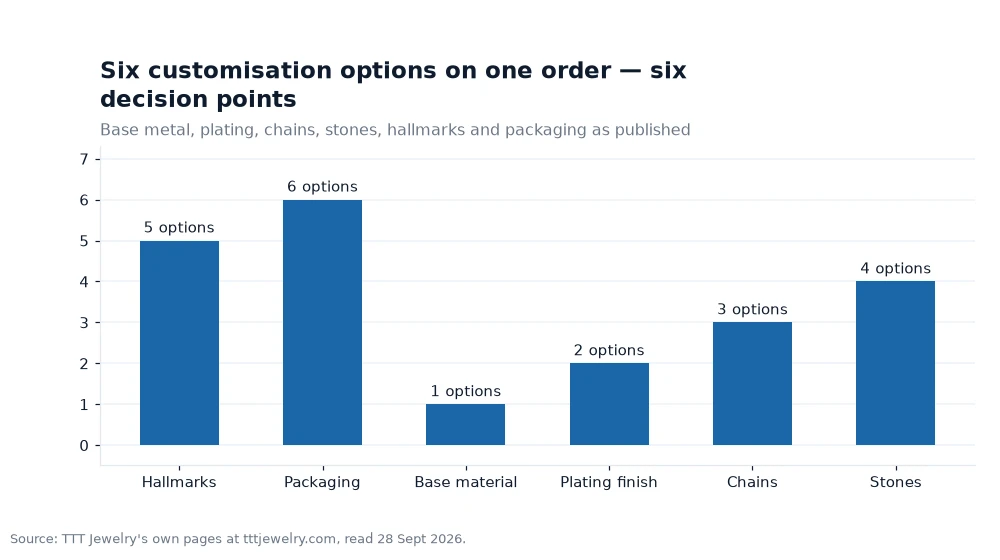
The chart is a reminder that finishing decisions sit inside a wider order. Plating is one of six customisation points, and it is the one most often left until the sample is already on the bench.
Frequently asked questions
Does polishing remove metal from a silver casting?
Yes. Polishing is abrasive, so it cuts a thin layer from the surface to level scratches and casting skin, which is why a deep defect is corrected before plating rather than polished out afterwards.
Can a plated piece still carry an S925 hallmark?
The hallmark describes the base metal, and S925 is one of the published marking options, so the finish should be stated separately in the product listing to avoid confusion about what the mark covers.
Why do silver and stainless steel need different finishing routes?
Silver is polished and then electroplated, with an optional anti-tarnish coating, while stainless steel takes PVD vacuum plating, so the two materials can share a look without sharing a process.
Writing the finish into the order
A finish spec that names the polish, the surface pattern, the plate colour and the coating removes most of the ambiguity that appears at sample approval. It also makes a reorder predictable, because the bench repeats a written sequence rather than an impression.
For a first run, the 50-piece threshold on 925 sterling silver keeps the commitment small enough to test two finishes side by side. The factory direct manufacturing route keeps polishing, surface art and plating on one line, which is where handovers between steps are easiest to control.
Ask for the inspection record with the shipment. It is the only document that shows whether the finish on the fiftieth piece matched the finish on the first.
Source note: figures come from the manufacturer's own website (tttjewelry.com), read 28 Sept 2026.[1]